God’s Pictures: Unveiling Divine Symbolism in John 2
God’s Pictures
Unveiling Divine Symbolism in John 2
Summary
In this study of John 2, we explore how God uses powerful pictures and symbols throughout Scripture to reveal His redemptive plan. From the first miracle of Jesus—turning water into wine at the wedding in Cana—to rich connections with the plagues of Egypt, Jewish wedding customs, and Old Testament imagery, we see how every detail points to Christ’s transforming work and the new covenant of grace.
Key Questions
Here are some thought-provoking questions to consider as we dive into the chapter:
Who remembers the first plague God brought on Egypt?
What was the first miracle Jesus performed?
What does wine represent in the New Testament?
What was the last plague God brought on Egypt?
What was the last major thing Jesus did before being crucified?
Jesus’ First Miracle: Water Turned into Wine
We will be looking at Jesus’ first miracle: turning water into wine at the wedding in Cana (John 2:1-10).
Before reading the chapter, take time to study the explanation of Jewish wedding customs below. These traditions provide a beautiful backdrop for understanding the deeper spiritual meaning of this miracle.
Read John 2:1-10
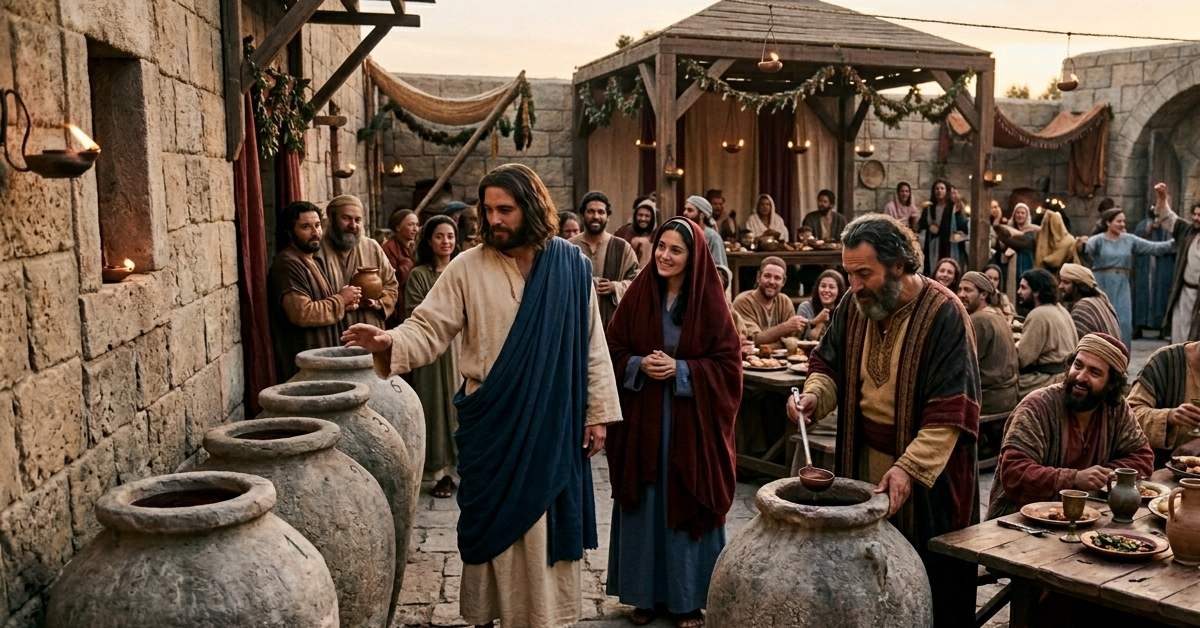
Jesus directs the servants at the wedding feast in Cana. Notice the six stone waterpots — symbolizing humanity and the incompleteness of the old covenant.
Key Details and Symbolism from the Miracle
Most Jewish weddings occur on Tuesday.
Fill the waterpots with water: The servants, under the direction of Jesus, were in a unique place of blessing. Jesus wanted the cooperation of men in this miracle. He could have filled the pots Himself or simply created the wine in them, but He chose to involve the servants so they could share in the work—and in the blessing.
Symbolism of the Number Six: In biblical numerology, six often represents imperfection or humanity, standing one short of the number seven (perfection). This suggests that the old Law (represented by the six waterpots) was incomplete until fulfilled by Jesus.
Ritual Purification: The pots were used for “Jewish purification rites” (washing hands and vessels), symbolizing the external cleansing of the old covenant.
Significance of Stone: The jars were made of stone, not clay, because stone was believed to be non-porous and could not hold ritual impurity.
Abundance (The Miracle): The jars were massive, holding roughly 120–180 gallons total (20–30 gallons each). This signifies the overwhelming, abundant grace of the new covenant.
Transformation of the Old: By filling these specific containers with new wine, Jesus illustrates that He is not just improving the old systems but replacing the old, insufficient systems of cleansing.
They filled them up to the brim: The waterpots were filled completely—with no room to add anything more—because Jesus wasn’t adding something to the water; He was transforming it entirely.
The First-Century Jewish Wedding: A Beautiful Picture of Christ and the Church
In the first century, a Jewish wedding was a two-stage process—Erusin (Betrothal) and Nissuin (Marriage)—typically separated by about a year.
1. The Betrothal (Erusin)
The process began with the legal establishing of the marriage covenant at the home of the bride’s father.
The Price (Mohar): The groom’s father paid a “bride price” to the bride’s family. This was financial protection for her. Picture: The price our Father paid was the life of His Son.
The Marriage Contract (Ketubah): A written contract was signed, outlining the groom’s responsibilities. Picture: This represents us giving our lives to Christ.
The Wine Ceremony: A cup of wine was poured. The groom offered it to the bride; by drinking it, she gave her consent. Once she drank, they were legally married, though they did not yet live together. Connection: At the Last Supper, Jesus said, “I tell you, I will not drink from this fruit of the vine from now on until that day when I drink it new with you in my Father’s kingdom” (Matthew 26:29).
2. The Period of Preparation
Preparing a Room: The groom would build a “bridal suite” onto his father’s house. Scripture: “My Father’s house has many rooms… I am going there to prepare a place for you” (John 14:2-3).
The Father’s Approval: Only the father decided when the home was ready. If asked about the wedding date, the groom would say only his father knew. Scripture: “But of that day and hour no one knows, not even the angels of heaven, but My Father only” (Matthew 24:36).
The Bride’s Waiting: The bride prepared her garments and kept her oil lamps ready, as the groom’s arrival would be a surprise. Picture: This is a call for us to stay pure, separated from the world, filled with the Word of God and the Holy Spirit.
3. The Marriage Ceremony (Nissuin)
The Procession: The groom and his companions arrived with a shout and the sound of the shofar. A torchlit procession followed. Scripture: “And He will send His angels with a great sound of a trumpet, and they will gather together His elect…” (Matthew 24:31).
The Bride’s Mikveh (ritual immersion).
The Wedding Feast: A week-long celebration with music, dancing, and a sumptuous feast began. Scripture: “Blessed are those who are called to the marriage supper of the Lamb!” (Revelation 19:9).
Consummation: The couple was escorted to the bridal chamber (Huppah). Picture: This represents the completion and end of God’s redemptive work.
Did Jesus Make Real Wine?
Yes. The Greek word used in John 2 is οἶνος (oinos) — the standard term for fermented grape wine, appearing 33–34 times in the New Testament. It is the same word used in Ephesians 5:18 (warning against drunkenness) and in the parables about new wineskins.
There is a different Greek word for unfermented grape juice (γλεῦκος / gleukos), which appears only once in Acts 2:13 and refers to fresh, sweet juice. John deliberately chose the word for actual wine.
Other Powerful “God’s Pictures” in the Bible
Moses Striking the Rock (Exodus 17 & 20):
God told Moses to strike the rock once (a picture of Christ being crucified). Later, God told him to speak to the rock, but Moses struck it in anger—ruining the picture. (You can’t crucify Christ twice.) Because he represented the Law, Moses was not allowed to lead the people into the Promised Land. Only Joshua (Yeshua/Jesus) could do that.
The Sabbath Day:
Six is the number of man; seven is the number of completeness and rest. The Sabbath is a picture of our rest in Christ. God commanded that anyone caught working on the Sabbath should be killed. Why? Because if you try to work your way into heaven, you will die spiritually.
Jesus Nailed to the Cross — The New Tree of Life:
The cross replaced the Tree of Knowledge that brought the fall.
• Nails through the hands: Hands represent the work of the Law, now nailed to the cross.
• Nail through the feet: Represents submission and servitude—Jesus as a “slave” to the will of God for our salvation.
• Pierced side (water and blood): “Without the shedding of blood there is no forgiveness” (Hebrews 9:22). The water symbolizes purification and the Holy Spirit.
Jonah in the Fish:
This is the “sign of Jonah” (Matthew 12:40)—three days and nights in the heart of the earth, picturing Christ’s crucifixion, death, and resurrection.
Bloopers and Poor Works
Actors are laughing — the directors and producers are not.
In the same way, poor works will not stand the test of fire:
“If any man’s work shall be burned, he shall suffer loss: but he himself shall be saved; yet so as by fire.” (1 Corinthians 3:15)
Our salvation is secure in Christ, but the quality of our works matters for eternity. Let us build with gold, silver, and precious stones—not wood, hay, and stubble.
We use cookies on our website to give you the most relevant experience by remembering your preferences and repeat visits. By clicking “Accept”, you consent to the use of ALL the cookies.
This website uses cookies to improve your experience while you navigate through the website. Out of these, the cookies that are categorized as necessary are stored on your browser as they are essential for the working of basic functionalities of the website. We also use third-party cookies that help us analyze and understand how you use this website. These cookies will be stored in your browser only with your consent. You also have the option to opt-out of these cookies. But opting out of some of these cookies may affect your browsing experience.
Necessary cookies are absolutely essential for the website to function properly. These cookies ensure basic functionalities and security features of the website, anonymously.
Cookie
Duration
Description
cookielawinfo-checbox-analytics
11 months
This cookie is set by GDPR Cookie Consent plugin. The cookie is used to store the user consent for the cookies in the category "Analytics".
cookielawinfo-checbox-functional
11 months
The cookie is set by GDPR cookie consent to record the user consent for the cookies in the category "Functional".
cookielawinfo-checbox-others
11 months
This cookie is set by GDPR Cookie Consent plugin. The cookie is used to store the user consent for the cookies in the category "Other.
cookielawinfo-checkbox-necessary
11 months
This cookie is set by GDPR Cookie Consent plugin. The cookies is used to store the user consent for the cookies in the category "Necessary".
cookielawinfo-checkbox-performance
11 months
This cookie is set by GDPR Cookie Consent plugin. The cookie is used to store the user consent for the cookies in the category "Performance".
viewed_cookie_policy
11 months
The cookie is set by the GDPR Cookie Consent plugin and is used to store whether or not user has consented to the use of cookies. It does not store any personal data.
Functional cookies help to perform certain functionalities like sharing the content of the website on social media platforms, collect feedbacks, and other third-party features.
Performance cookies are used to understand and analyze the key performance indexes of the website which helps in delivering a better user experience for the visitors.
Analytical cookies are used to understand how visitors interact with the website. These cookies help provide information on metrics the number of visitors, bounce rate, traffic source, etc.
Advertisement cookies are used to provide visitors with relevant ads and marketing campaigns. These cookies track visitors across websites and collect information to provide customized ads.